

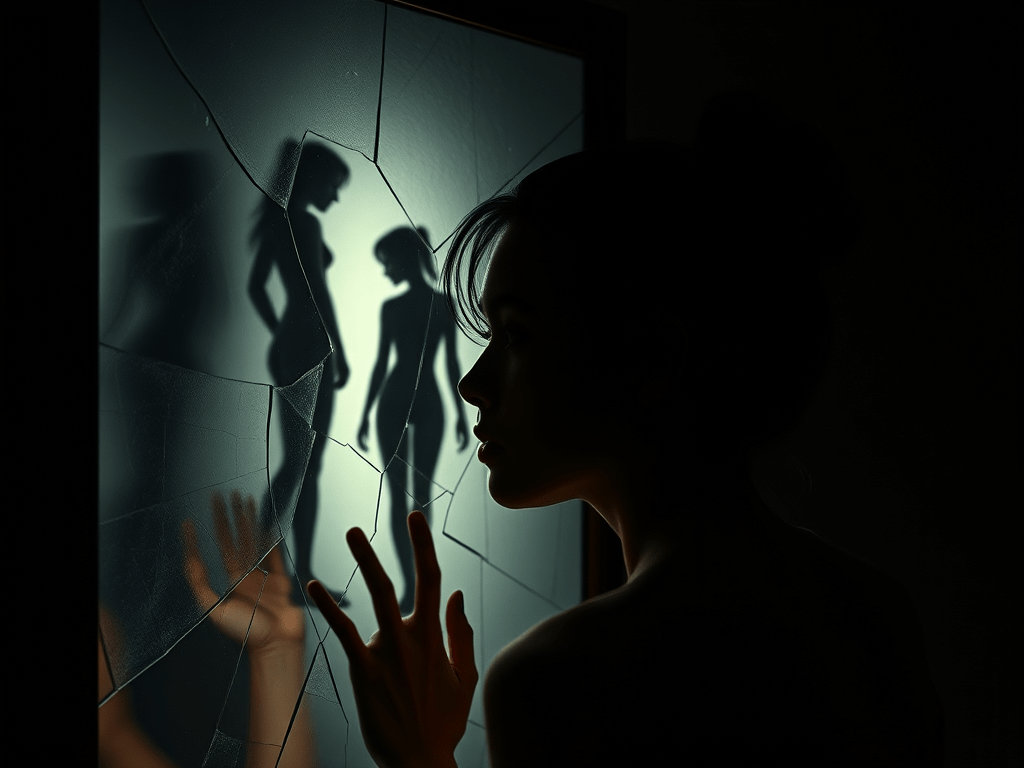

A Spiral into Hunger, Control, and Cultural Ghosts
There’s a question that floats like a feather and lands like a brick:
Why anorexia?
Not “what is it,” not “how do we treat it,” but the deeper, messier, more relational why.
Why does a person, often bright, sensitive, and perceptive, begin to disappear themselves?
Why does hunger become a language?
Why does control become a comfort?
Let’s spiral gently into that.
The Ghost in the Mirror: Cultural Messaging and the Vanishing Act
We live in a culture that worships the disappearing woman.
Not literally, of course, though sometimes, yes, literally.
But symbolically, the smaller, quieter, more contained she is, the more she is praised.
Slim down. Tone up. Be less. Take up less space.
Even empowerment campaigns often come with a side of “but make it aesthetic.”
Anorexia isn’t just about food.
It’s about messaging.
It’s about the emotional logic of a world that says:
- You are safest when you are smallest.
- You are most loved when you are most controlled.
- You are most powerful when you are most pleasing.
And so, the body becomes a battleground.
Not for vanity, but for survival.
Control as Comfort: The Emotional Architecture
Here’s the twisty bit:
Anorexia often doesn’t feel like punishment.
It feels like precision. Like relief. Like finally, something makes sense.
When the world feels chaotic, when relationships feel unpredictable, when emotions feel too big to hold,
Restricting food becomes a way to build walls.
Not to shut people out, but to keep the self from spilling over.
It’s not about wanting to die.
It’s about wanting to feel safe enough to live.
And yes, that’s a paradox.
But so is being human.
Hunger as Language: What Gets Said Without Words
There’s a kind of poetry in hunger.
Not romantic, not glamorous, just raw.
It says:
- I am not okay.
- I need something I cannot name.
- I am trying to make sense of a world that doesn’t make sense.
And because we don’t always have the words, especially in cultures that prize stoicism, politeness, and “getting on with it,”
The body speaks.
It whispers through skipped meals.
It shouts through brittle bones.
It sings through the silence of a dinner untouched.
This isn’t manipulation.
It’s expression.
The Tension: Visibility vs. Invisibility
Here’s the cruel irony:
Anorexia makes you invisible and hyper-visible at the same time.
People notice the weight loss.
They comment. They worry. They praise. They panic.
But they often miss the why.
They miss the ache.
They miss the emotional scaffolding that’s holding the whole thing up.
And so, the person inside the body feels more alone than ever.
Seen, but not understood.
Visible, but not known.
Reframing the Mirror: What If the Body Isn’t the Problem?
Let’s play with a reframe.
What if anorexia isn’t a body issue, but a relational issue?
What if it’s not about food, but about belonging?
About the agency?
About emotional safety?
What if the person isn’t broken, but brilliant, just trying to survive in a system that doesn’t know how to hold them?
This isn’t to romanticise the pain.
But it is to honour the intelligence behind it.
Because anorexia often emerges in people who feel deeply.
Who notice everything.
Who want to do things right.
Who care too much and have nowhere to put it.
So maybe the question isn’t “why anorexia?”
Maybe it’s “what does this person need that they haven’t been given?”
Soft Tools for Gentle Repatterning
No fixes here. Just invitations.
Notice the patterns, not just the behaviours.
What feels safe? What feels chaotic? What feels like too much?
Offer language where silence has lived.
Can you name the ache? Can you name the need? Can you name the fear?
Build relational scaffolds.
Not just therapy (though yes, therapy). But also, friendship, creativity, rhythm, rest.
Reclaim hunger as a guide, not a threat.
What are you hungry for, emotionally, relationally, spiritually?
These aren’t cures.
They’re companions.
Final Thought: The Body as a Poem, Not a Problem
Anorexia isn’t a failure.
It’s a signal.
A system of meaning.
A way the body tries to say:
“I need something. I’m trying to find it.”
And maybe the most radical thing we can do is listen.
Not just to the symptoms, but to the soul behind them.
Because the goal isn’t just recovery.
It’s reconnection.
To self. To others. To the messy, beautiful, chaotic rhythm of being alive.
Let’s stop asking people to shrink to fit.
Let’s build a world where they can expand.
 Bloggyness
Drop a Thought, Stir the Pot