

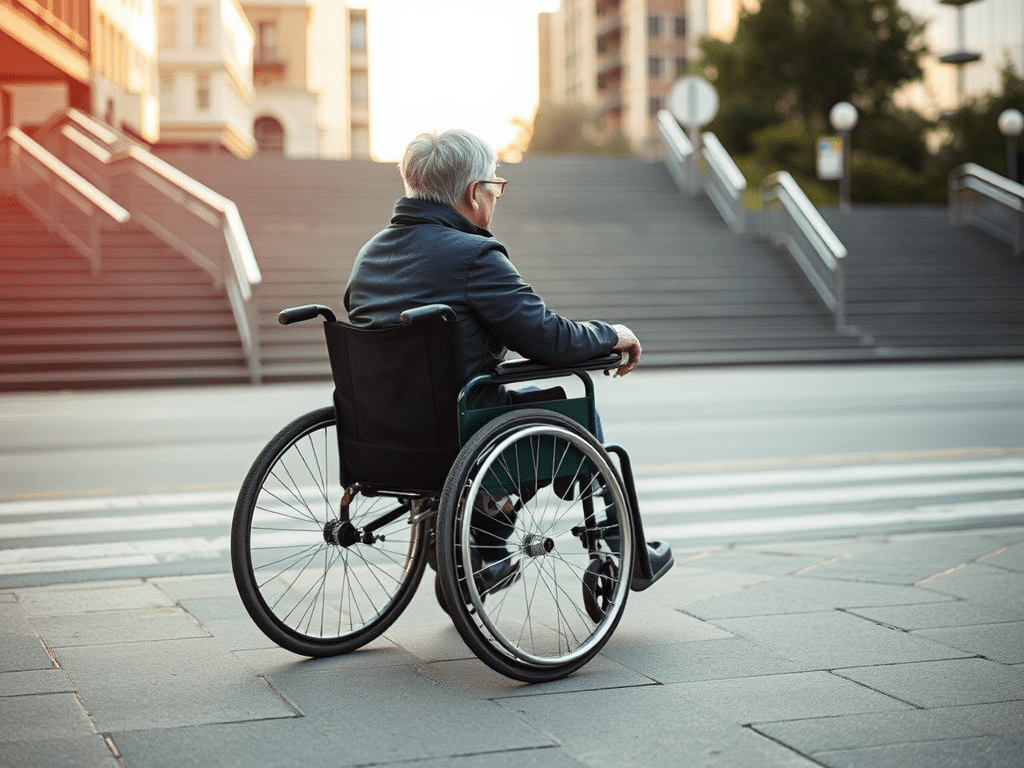
Disability, Dignity & the Daily Dance of Getting Around
Let’s be honest: the world wasn’t exactly built with disabled people in mind. And while ramps, lifts, and “accessible” toilets are slowly popping up like reluctant mushrooms after a drizzle, the reality is still full of friction. Using a wheelchair, or any mobility aid, isn’t just about getting from A to B. It’s about navigating a world that often forgets you exist until you’re blocking a doorway or asking for a ramp that mysteriously leads to nowhere.
So, let’s spiral into it. Not to fix it, but to feel it. To name the nonsense, celebrate the resilience, and gently nudge the world toward something better.

The Myth of “Accessible”
Ah, “accessible.” That magical word that gets slapped on buildings, websites, and events like a badge of honour. But let’s unpack it, shall we?
- A ramp that’s steeper than a ski slope? Not accessible.
- A “disabled toilet” that doubles as a mop cupboard? Not accessible.
- A venue with step-free access… but only through the back alley past the bins? You guessed it; not accessible.
Accessibility isn’t just about ticking boxes. It’s about dignity. It’s about being able to show up without having to apologise for your existence. And frankly, the bar is still far too low.

The Emotional Tax of Just Existing
Using a wheelchair or living with any disability comes with an emotional tax that non-disabled folks rarely see.
There’s the constant calculation: Can I get in? Will there be space? Will someone stare? Will I have to explain myself again?
There are the microaggressions: “You’re so brave!” “I don’t see you as disabled!” “Can you have sex?”
And then there’s the sheer exhaustion of having to advocate for yourself every single day. It’s not just tiring; it’s dehumanising.
Soft prompt: Next time you see someone navigating the world differently, ask yourself: “What assumptions am I making?” Then gently unmake them.

Wheelchairs: Freedom Machines or Friction Magnets?
Let’s talk chairs. Manual, powered, hybrid; each comes with its own joys and dramas.
- Manual chairs are great for short distances and tight spaces, but they require serious upper-body strength. Hills? Cobblestones? A nightmare.
- Powered chairs offer independence and comfort, but they’re bulky, expensive, and often treated like alien spacecraft by public transport staff.
- Hybrid options exist, but they’re not always available through the NHS, and private purchase can cost more than a second-hand car.
And don’t get me started on the bureaucracy. Getting the right chair often involves assessments, waiting lists, and enough paperwork to wallpaper a bungalow.

The Social Side of Struggle
Disability isn’t just physical; it’s social. It’s the awkward silences when someone doesn’t know what to say. It’s the exclusion from spontaneous plans because “we didn’t think it’d be accessible.” It’s the loneliness of being left out; not because people are cruel, but because the world is designed to forget.
But here’s the twist: disabled people are some of the most creative, resilient, and community-minded humans you’ll ever meet. We build networks, share hacks, and turn struggle into solidarity.
Soft prompt: If you’re planning something, ask: “Who might be excluded by default?” Then make it better by design.

Soft Actions
- When have I assumed accessibility without checking?
- How do I respond when someone asks for help or accommodation?
- What stories about disability have I internalised, and are they true?
What you can do to help
- Learn the difference between accessible and inclusive.
- Follow disabled creators, bloggers, and activists (especially UK-based voices like Ross Lannon).
- Audit your spaces; physical, digital, social; for friction points. Then fix one.

Final Thought
Disability isn’t a tragedy; it’s a reality. And wheelchairs aren’t symbols of limitation; they’re tools of liberation. But liberation shouldn’t come with a side of struggle. It should be baked into the design, the culture, the conversation.
So, let’s stop pretending that “accessible” means “good enough.” Let’s spiral toward something better; something that feels like dignity, ease, and a quiet “yes, you belong here.”
For deeper dives, shared tools, and future rituals, visit us.
 Bloggyness
Drop a Thought, Stir the Pot