

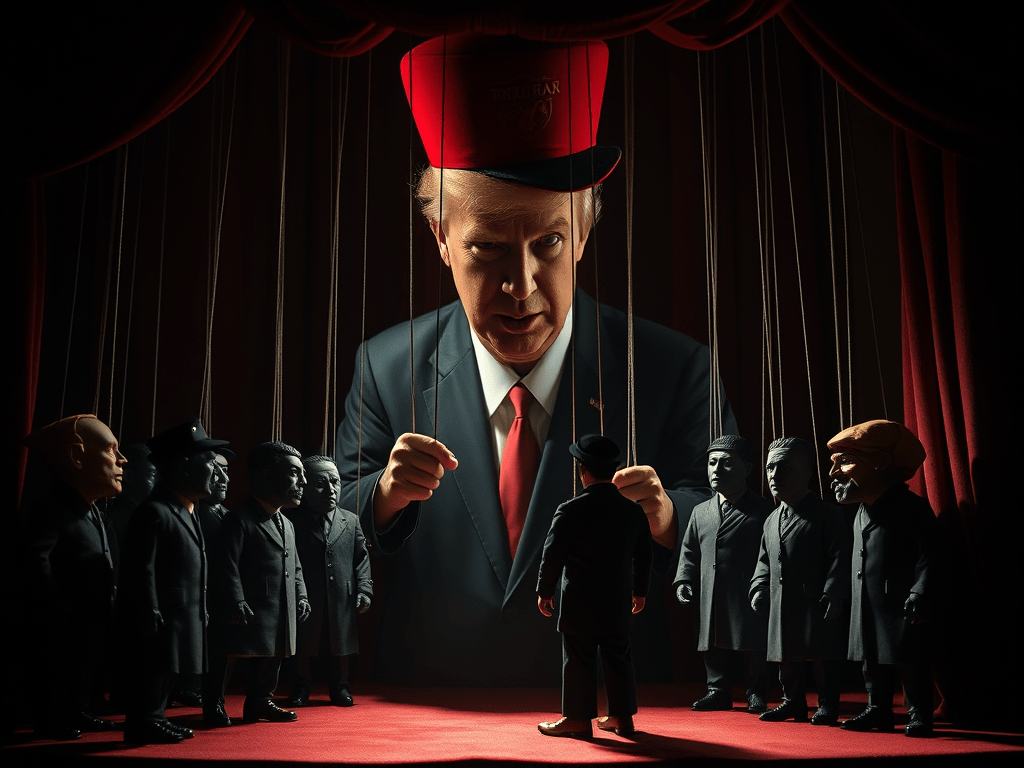
When Donald Trump bellows on Truth Social that Cuba propped itself up on Venezuelan oil and repaid the favour by providing “Security Services” to “the last two Venezuelan dictators, BUT NOT ANYMORE!” he isn’t exposing tyranny.
He’s laundering power.
This isn’t analysis. It’s theatre. And like all good authoritarian theatre, it needs villains, absolutes, and a messiah figure to declare the story finished. Trump doesn’t describe geopolitics; he narrates himself as the executioner of history.
“BUT NOT ANYMORE!” isn’t information. It’s a coronation.

Dictators Love Pointing at Other Dictators
Here’s the oldest trick in the strongman playbook: accuse others of the very thing you are perfecting.
Trump is obsessed with dictators because dictators validate his worldview. They make power legible. They reduce politics to dominance, loyalty, punishment, and spectacle. When he condemns Havana and Caracas, he isn’t rejecting authoritarianism; he’s critiquing competitors.
He doesn’t hate dictatorship. He hates a dictatorship that isn’t his.
Calling foreign leaders tyrants lets him posture as a liberator while rehearsing the same habits at home: contempt for institutions, hostility to oversight, loyalty tests, public shaming, and the casual suggestion that only he can fix it all.
That’s not a coincidence. That’s alignment.
The Smoke Screen: Foreign Villains, Domestic Decay
The fixation on Cuba and Venezuela is convenient. Safe. Distant.
While eyes are dragged south, the real damage happens quietly:
- Courts are dismissed as corrupt when they rule against him
- Elections are trusted only when he wins
- Journalists become “enemies”
- Truth becomes whatever survives the loudest repetition
This is how authoritarianism metastasises in modern democracies, not with tanks, but with distraction. Not with coups, but with outrage cycles.
Foreign dictators are the smoke screen. Domestic power consolidation is the fire.
The Real Dictator Isn’t a Man, It’s a System Wearing a Man
Here’s the uncomfortable truth people avoid because it ruins the simplicity of heroes and villains:
The real dictator might not be Trump alone.
It might be:
- A cult of personality that rewards cruelty as strength
- A platform economy that turns rage into currency
- A base trained to equate loyalty with virtue and doubt with treason
- A political culture addicted to certainty over truth
Trump didn’t invent this. He exploited it. Perfected it. Monetised it.
In that sense, he’s less a lone tyrant and more a symptom of the human interface for a system that no longer values accountability, only dominance.
Dictatorship, in the 21st century, doesn’t always wear a uniform. Sometimes it wears a red hat and calls itself freedom.
Language Is the First Weapon
Authoritarianism begins in the mouth.
When Trump declares who is legitimate and who is not, who is a dictator and who is a saviour, he is doing the most dangerous thing a political figure can do: collapsing complexity into obedience.
If he defines reality, then disagreement becomes deviance.
If he names the enemy, then questioning him becomes betrayal.
If he declares “it’s over,” then facts no longer matter.
This is how power escapes limits, not by force, but by narrative capture.
The Final Irony
Trump rails against Cuban security services and Venezuelan repression while demanding personal loyalty from judges, generals, lawmakers, and voters.
He mocks authoritarian states while flirting openly with authoritarian methods.
He warns about dictators abroad while rehearsing the language of one at home.
That’s not hypocrisy. That’s rehearsal.
The Question We Keep Dodging
So forget Cuba. Forget Venezuela. Forget the comfortable fiction that dictators always live somewhere else.
Ask the harder question:
What happens when millions willingly hand their judgment to one man because he makes them feel powerful by proxy?
Because when people stop asking who holds power and start cheering when someone seizes it, the dictator has already arrived.
He doesn’t need to declare himself.
The crowd does it for him. Something to think about!
 Bloggyness
Drop a Thought, Stir the Pot