

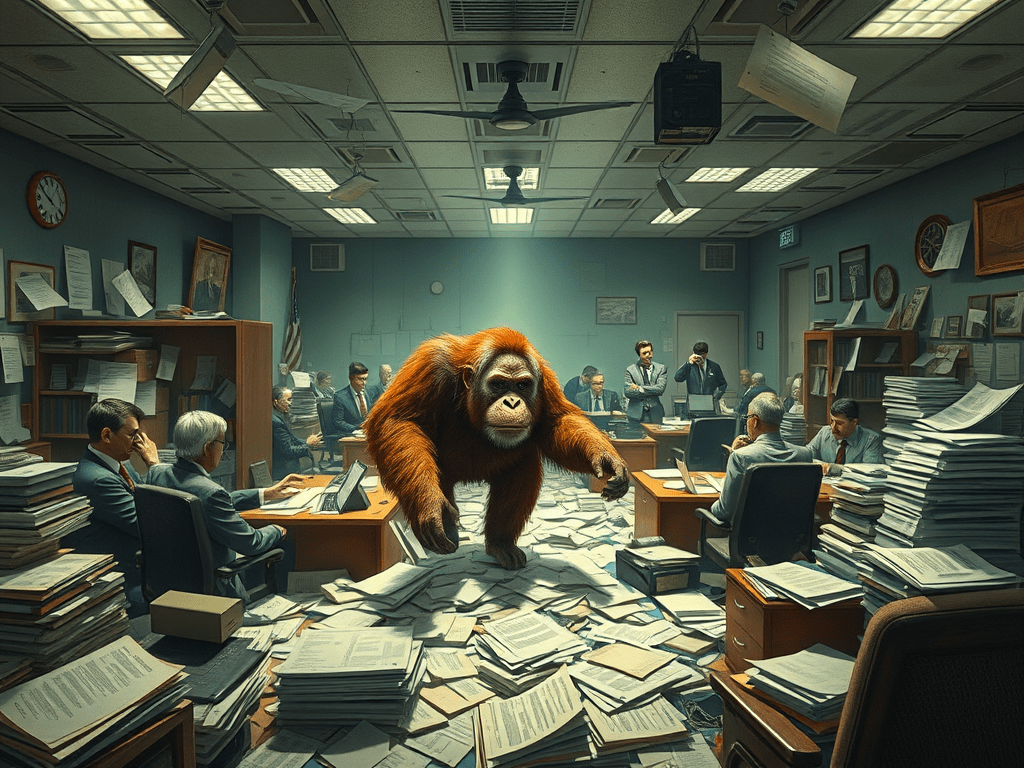
Imagine being told your house is about to be remodelled.
Walls knocked down. Rooms merged. Kitchen relocated to the attic.
You ask: “How much will this cost?”
And the builders reply: “Oh, we didn’t actually do the sums ourselves. We borrowed a report from someone else, from a few years back. Don’t worry, it’ll be fine.”

This is not a sitcom plot.
This is England’s current approach to council reorganisation.
The UK government has embarked on the biggest reshuffle of local governance in decades, merging, reshaping, and redrawing the map without doing its own cost analysis.
Instead, it borrowed a consultancy report like a student who forgot their homework and panicked in the library.
Anxiety, Cynicism, and Shrugs (Mostly Shrugs)
Local government is not glamorous.
It’s bins, potholes, care homes, and planning permissions.
It’s the infrastructure of daily life minus the drama, plus the paperwork.
When reorganisation is announced, the emotional responses are:
- Council staff: Anxiety. Will my job still exist? Will I be merged, duplicated, or gently erased like a forgotten spreadsheet tab?
- Residents: Cynicism. Will this improve services, or just mean longer waits and fewer humans at the counter?
- Politicians: Shrugs. Reorganisation is framed as “tidying up the map,” but emotionally it’s more like rearranging deckchairs on a budget spreadsheet.
And the absence of government-led cost analysis?
It adds a layer of distrust so thick you could pave a pothole with it.
The Myth of Efficiency (Now with Extra Buzzwords)
The government’s line is familiar:
Bigger councils mean streamlined services, fewer duplicated roles, and therefore savings.
Translation:
“We’ve read a report. It had graphs. We’re feeling confident.”
But efficiency is not neutral.
It’s a cultural value dressed up as a spreadsheet.
- Efficiency often means centralisation.
- Centralisation often means distance.
- Distance often means disconnection.
- Disconnection often means someone crying in a car park because the housing office moved to a postcode they can’t pronounce.
The myth is that efficiency always equals improvement.
In reality, it can hollow out relationships, strip away local flavour, and leave people feeling like numbers in a PowerPoint deck titled “Transformation Journey.”
Between Care and Calculation (And a Bit of Chaos)
Here’s the rub:
Councils are not just service providers.
They are care infrastructures.
They hold:
- The elderly neighbour who needs meals on wheels
- The family applying for housing
- The teenager needing youth services
- The person who just wants their bin collected without a 45-minute phone queue
When reorganisation is framed purely in terms of savings, the personal tension emerges:
- Do we value care as much as calculation?
- Do we measure success in pounds saved or lives supported?
- Do we allow humour, humanity, and local flavour to survive in the new structures, or do we replace them with branded lanyards and vision statements?
The government’s decision not to do its own analysis is telling.
It suggests the numbers were never the point.
The story was efficiency.
The numbers were borrowed props like clipboards in a team-building exercise.
From Savings to Stewardship
So how might we reframe this?
Instead of asking, “How much money will this save?”
We could ask:
- “How will this reorganisation improve emotional safety for residents?”
- “How will it strengthen resilience in times of crisis?”
- “How will it honour local identity while building sustainable structures?”
- “Will it still feel like my council or just a call centre with a logo?”
This is where the Bloggyness ethos comes in
Treating infrastructure as care, not control.
Reorganisation could be an opportunity to design councils as living companions, modular, resilient, and emotionally intelligent.
But only if we resist the narrow frame of efficiency.
And maybe stop borrowing reports like panicked undergrads.

Final Thought
Council reorganisation is not just about maps and mergers.
It’s about how we value care, how we define efficiency, and whether we’re willing to do the maths ourselves.
The tragedy is that the spreadsheet often wins.
But the invitation is clear:
We can reimagine governance as stewardship, not streamlining.
As companionship, not control.
As bins and backlogs with heart.
Because if we’re going to redraw the map, let’s make sure it still leads somewhere human.
Explore more with us:
- Browse Spiralmore collections
- Read our Informal Blog for relaxed insights
- Discover Deconvolution and see what’s happening
- Visit Gwenin for a curated selection of frameworks
 Bloggyness
Drop a Thought, Stir the Pot