
(A sassy guided tour through the museum of your life featuring cables, nostalgia, and questionable decisions)
The Box of Mystery We Pretend Isn’t There
There is absolutely a box in your house full of things you haven’t used since the early reign of Nokia. You don’t know exactly what’s inside it, but you know it exists. Old cables. A phone that died in 2014. Instruction manuals for appliances that have long since ascended to Valhalla. A birthday card. A key that unlocks nothing in your current reality.
We keep an astonishing amount of useless stuff. And the wild part? We know it’s useless. We keep it anyway.
The Drawer of Ancient Cables (A.K.A. The Shrine of “Just in Case”)
Every home has one. A drawer filled with cables that look like they belong to a lost civilisation.
USBs from 2007. Charging leads for devices that no longer exist. A connector that resembles alien technology. And of course, the cable you’re absolutely certain you’ll need one day.
You won’t. But you keep it because of that tiny, traitorous whisper: “What if?”
We’re not keeping the object. We’re keeping the possibility.
We Don’t Just Keep Things; We Keep Potential
That camping stove? Might be useful one day. The spare chair? Could be needed. The box? Might come in handy. The mysterious screw? Probably belongs to something important (it doesn’t).
Eventually, the object isn’t being kept because it’s useful. It’s being kept because throwing it away feels like tempting fate.
The Useless Things That Aren’t Useless at All
Then there are the sentimental gremlins:
A concert ticket. A postcard. A child’s drawing. A shell from a beach. A note from someone you loved. A photograph from a life that doesn’t exist anymore.
These things aren’t useful. But usefulness was never the point.
They are proof. Evidence. Little time machines.
They say: This happened. You were here. You lived this.
Why Decluttering Turns into Emotional Archaeology
You start with: “I’ll just sort this drawer.”
Forty minutes later, you’re sitting on the floor holding something from fifteen years ago, suddenly remembering:
A house. A person. A holiday. A version of yourself you haven’t thought about in ages.
The tidy-up has stopped. You’ve accidentally opened a portal.
The Decluttering Advice That Sometimes Misses the Point
We’re told:
Keep what you need. Get rid of what you don’t use. Ask if it sparks joy. Don’t let possessions control you.
All fine. All reasonable.
But not everything needs to justify its existence. Some things you keep simply because you like having them. That’s enough.
We Also Keep Old Versions of Ourselves
This is the spicy bit.
Your possessions are tiny biographies:
The books you read. The clothes you wore. The hobbies you tried. The tools from old jobs. The things you collected. The things you thought you’d become.
Getting rid of them can feel like erasing a former self.
You’re not deciding whether to keep an old guitar. You’re deciding whether you still want to be the person who was going to learn guitar.
The Things We Bought for Our Imaginary Future Selves
We are excellent at this.
Running shoes for the runner you were going to be. Cookware for the chef you were absolutely becoming. Notebooks for the organised person arriving next Monday. Tools for the project you’ll definitely start.
It’s optimistic. It’s sweet. It’s human.
Sometimes the future arrives. Sometimes it doesn’t. The object remains.
The Gifts We Can’t Throw Away (Even If We Want To)
Decluttering gets complicated when someone else gives you the thing.
Throwing it away feels like throwing away the affection behind it. Even if you’ve never used it. Even if it’s hideous. Even if it’s lived in a cupboard for fifteen years.
Logic says: “It’s just an object.”
Emotion says: “Absolutely not.”
The Fear of Waste (A Classic Trap)
We keep things because we paid for them.
“I spent £40 on this.” “I might use it.” “I should get value from it.”
But the money is already gone. Keeping the object doesn’t recover it. It just converts a financial mistake into a storage problem.
Sometimes the most sensible thing is admitting: That was a bad purchase. And moving on.
Our Homes Are Museums: Chaotic Ones
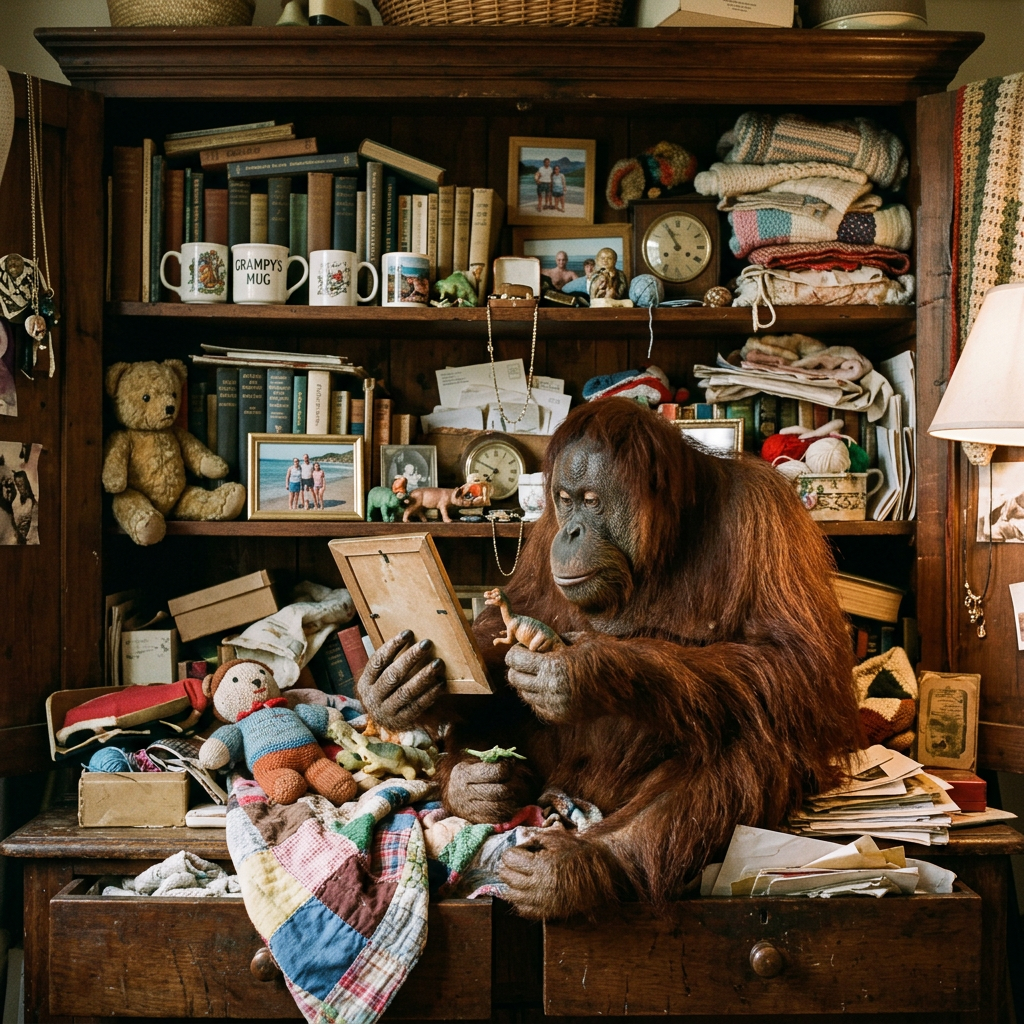
A mug from an old workplace. A photograph from a holiday. A book someone recommended twenty years ago. A stone from a beach. A broken object nobody has repaired. A box that hasn’t been opened since the last house move.
These are exhibits. Evidence. Stories.
Your home is a museum of your life, messy, human, and real.
But We Don’t Have to Keep Everything
Sentimentality can become a burden. If everything is precious, nothing has space.
You don’t need every version of yourself. You don’t need every notebook. You don’t need every birthday card. You don’t need every cable.
Especially not seven identical extension leads.
Sometimes the Memory Is Enough
You can photograph an object. Write down the story. Keep one representative item instead of fifty. Pass something on. Or simply remember.
The object triggers the memory, but it isn’t the memory itself.
That’s liberating.
And Sometimes You Should Keep the Ridiculous Things
Keep the silly mug. Keep the weird object nobody else understands. Keep the thing that makes you laugh. Keep the item that makes no sense but feels right.
A home isn’t a warehouse. It’s allowed to contain nonsense.
The Next Time You Open That Cupboard…
You’ll find something you’ve kept for twenty years.
Ask:
Do I use this? Do I need it? Do I like it? Would I miss it?
If the answer is no, let it go. If the answer is yes, keep it. If the answer is:
“I have absolutely no idea why I still have this, but I’d be genuinely upset if it disappeared…”
Well. There’s your answer.
Keep it.
Because the things we keep aren’t really about usefulness. They’re about continuity. About remembering the people we’ve been. About the places that vanished. About the days that quietly became memories.
And somewhere in all the clutter is the physical record of a life that actually happened.
Even if half of it is just old cables.

Leave a Reply